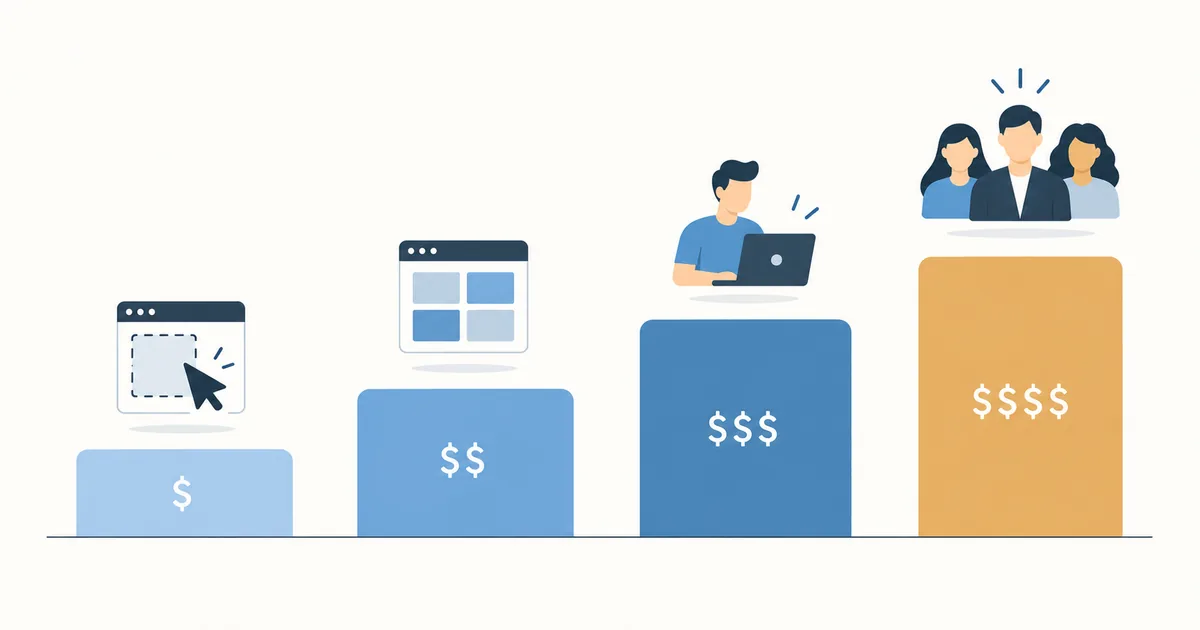
That range is uselessly wide until you know where you sit inside it. This guide breaks down real 2026 pricing by project type, explains what drives cost up or down, and shows you the ongoing expenses most quotes conveniently leave out.
Website cost at a glance (2026)
| Website type | Upfront cost | Ongoing annual cost | Typical timeline |
|---|---|---|---|
| DIY website builder | $0–$500 | $200–$600 | 1–2 weeks |
| Template site (freelancer) | $800–$3,000 | $300–$900 | 2–4 weeks |
| Custom small business site | $3,000–$10,000 | $600–$2,400 | 4–8 weeks |
| E-commerce store | $5,000–$40,000 | $1,200–$12,000 | 6–16 weeks |
| Custom web application | $25,000–$150,000+ | $5,000–$30,000 | 3–12 months |
| Enterprise / multi-site | $75,000–$500,000+ | $25,000+ | 6–18 months |
Quick answer: if you run a small business and want a credible, fast, mobile-friendly site with 5–10 pages, budget $3,000–$10,000 upfront and $800–$1,500 per year to keep it running. Those typical timelines assume your content is ready when the build starts.
What actually drives website cost
Price quotes vary wildly for the same brief because five variables move independently.
1. Page count and content volume
A five-page brochure site and a 60-page site with location pages are not the same product. Each unique page template adds design and development hours. Reusing one template across 40 pages is cheap; designing 40 distinct layouts is not.
2. Design approach
- Pre-built template, lightly customised: $500–$2,500
- Customised premium theme: $2,000–$6,000
- Fully custom design from scratch: $6,000–$30,000
Custom design means original wireframes, brand-specific UI, and multiple revision rounds. It is the single biggest lever on price.
3. Functionality
Standard pages are cheap. These are not:
- Payment processing and checkout: +$2,000–$15,000
- Booking or scheduling systems: +$1,500–$8,000
- User accounts and dashboards: +$4,000–$25,000
- Multi-language support: +$1,500–$10,000
- Custom CRM or API integrations: +$2,000–$20,000
- Advanced search and filtering: +$1,500–$9,000
4. Who builds it
Rates in 2026 vary by roughly 10x depending on model and geography, and who builds it changes what you’re actually buying as much as what you pay.
| Provider | Hourly rate (2026) | Best for |
|---|---|---|
| Offshore freelancer | $15–$45 | Tight budgets, simple builds |
| Onshore freelancer (US/UK/AU) | $60–$150 | Small–mid projects, direct communication |
| Small agency (2–15 people) | $100–$200 | Businesses needing strategy and execution |
| Mid-size agency | $150–$275 | Complex builds, multi-channel work |
| Enterprise consultancy | $250–$500+ | Regulated industries, large systems |
5. Strategy and content
Copywriting, SEO research, photography and information architecture are frequently excluded from quotes and then billed later. Realistically add:
- Professional copywriting: $150–$600 per page
- SEO setup and keyword research: $800–$5,000
- Brand photography: $800–$4,000
- Logo and brand identity: $1,000–$10,000
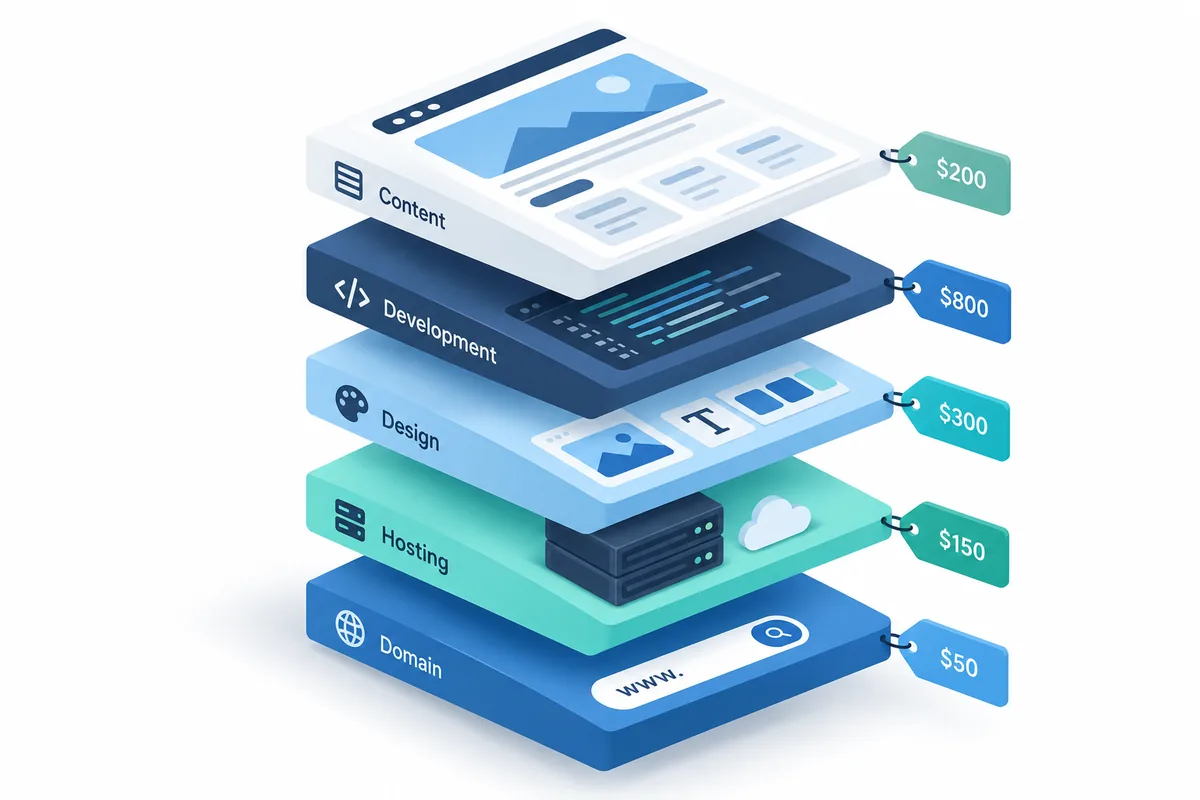
Cost by website type
Small business brochure website — $3,000–$10,000
Five to ten pages, custom design on WordPress or Webflow, contact forms, basic on-page SEO, mobile responsive, and analytics. This is the default answer for local service businesses, consultancies and professional practices.
E-commerce store — $5,000–$40,000
A Shopify store with a customised theme and up to 100 products typically lands at $5,000–$15,000. Costs climb with custom checkout logic, subscription billing, ERP integration or catalogues over 1,000 SKUs. Add transaction fees of roughly 2–3% on every sale, permanently — which is why store pricing deserves its own breakdown. See what an e-commerce website costs for pricing by store size and platform, or our e-commerce development page for where that money goes on a real build.
Web application or SaaS product — $25,000–$150,000+
Custom applications are priced by engineering time, not page count. Expect discovery, UX design, front-end and back-end development, QA and deployment. Anyone quoting a fixed $8,000 for “an app like Uber” is either misunderstanding the brief or planning to abandon it midway.
Website redesign — $4,000–$25,000
Redesigns are often cheaper than new builds because content and structure already exist — unless the migration involves URL restructuring, in which case budget for redirect mapping and SEO preservation. Google’s own site-move guidance is blunt about it: every old URL needs a permanent redirect to its closest new equivalent, or the page is a 404 to a crawler and whatever ranking it held is gone. Recovery, when mapping is skipped, is measured in months rather than weeks. It is the first thing a website audit should cost out before anyone agrees to a rebuild.
The hidden costs nobody quotes
The build fee is the visible tip. Below the waterline:
| Ongoing cost | Annual range | Notes |
|---|---|---|
| Domain registration | $10–$60 | Premium domains cost far more |
| Hosting | $60–$3,600 | Shared vs managed vs cloud |
| SSL certificate | $0–$300 | Often free via Let’s Encrypt |
| Premium plugins/themes | $100–$1,200 | Renewals are annual, not one-time |
| Maintenance and updates | $600–$6,000 | Security patches, backups, fixes |
| Content updates | $500–$5,000 | New pages, blog posts, offers |
| Email hosting | $70–$300 | Per user, per year |
| Backup and security tools | $100–$800 | Non-negotiable for e-commerce |
| Platform subscription | $200–$4,800 | Shopify, Webflow, HubSpot and similar |
A $6,000 website with $1,500 a year of upkeep costs $13,500 over five years. Budget for the five-year figure, not the launch invoice.

Freelancer vs agency: which costs less?
Freelancers cost 40–60% less on comparable scope. You are paying one person’s time with minimal overhead.
Choose a freelancer when: the scope is well defined, you can manage the project yourself, the budget is under $10,000, and you don’t need design, copy, SEO and development all handled at once.
Choose an agency when: the project touches multiple disciplines, you need accountability and continuity if someone leaves, there are compliance or integration requirements, or the website is a primary revenue channel where downtime is expensive.
The real risk with freelancers isn’t quality — plenty are excellent — it’s continuity. If they take a full-time job six months after launch, you own a codebase nobody else has documented. The full comparison covers the middle options too, which is where most of this decision actually gets made.

How to reduce website cost without regretting it
Safe ways to cut cost
- Launch with fewer pages and expand later — a great 6-page site beats a mediocre 20-page one.
- Use a high-quality premium theme instead of full custom design.
- Write your own copy from a supplied brief and structure.
- Supply your own photography or use quality stock initially.
- Phase the build: core site now, booking system in Q2.
- Choose a mainstream platform so future developers are easy to find.
Cuts that cost more later
- Skipping mobile optimisation — mobile and desktop each take roughly half of global web traffic, per StatCounter, so a desktop-only build writes off half your visitors.
- Skipping SEO fundamentals — retrofitting is more expensive than building it in.
- Choosing the cheapest bid without checking a portfolio or references.
- Accepting a build with no CMS, so every text change requires paying the developer.
- Refusing to pay for maintenance — until the hacked-site cleanup bill arrives.
How to read a website quote
A quote worth trusting names specifics. Before signing, confirm in writing:
- Deliverables: exact page count, number of unique templates, revision rounds included
- Platform and ownership: who owns the code, domain, hosting account and design files
- Timeline: milestone dates and what happens if you delay feedback
- Payment schedule: typically 30–50% deposit, remainder at milestones
- What’s excluded: copywriting, images, SEO, training, post-launch support
- Post-launch terms: bug-fix window (30–90 days is standard) and hourly rate afterwards
If a quote is a single line item with one number, it isn’t a quote — it’s a guess you’ll be renegotiating in week six.
Is a custom website worth it over a DIY builder?
For a business that gets under 500 visitors a month and needs a credible online presence, a well-configured Squarespace or Wix site at $400 a year is genuinely sufficient. The honest answer is that most microbusinesses over-invest at this stage.
Custom development earns its cost when the website is doing measurable work — generating leads, processing orders, integrating with operations, or ranking for competitive terms. At that point, a 15% conversion improvement on a site producing $200,000 in annual revenue pays for the entire build in one quarter.
How to budget for a website
Five steps, worth about two hours of thinking, done before you contact anyone. Quotes get dramatically more comparable when every supplier is answering the same brief.
1. Define the job the website must do
Write down the primary business outcome — lead generation, online sales, credibility — before considering features or price.
2. List required pages and functionality
Separate must-have functionality from nice-to-have features that can be phased into a later release.
3. Choose your build model
Decide between a DIY builder, a freelancer or an agency based on scope complexity and internal capacity to manage the project.
4. Add ongoing costs to the budget
Include hosting, domain, maintenance, security and content updates, and calculate the total five-year cost of ownership.
5. Request three quotes on an identical written brief
Compare quotes line by line, confirming deliverables, revision rounds, ownership of assets and post-launch support terms. If you want one of those three to be ours, get a written quote — we scope it against the same checklist above.
Frequently asked questions
How much does a website cost for a small business?
Most small businesses pay $3,000–$10,000 for a professionally designed custom website, plus $800–$1,500 per year in hosting and maintenance. Template-based builds by a freelancer can be completed for $800–$3,000.
How much does it cost to hire a web developer per hour?
In 2026, onshore freelance developers charge $60–$150 per hour, small agencies charge $100–$200 per hour, and offshore developers charge $15–$45 per hour. Enterprise consultancies range from $250 to $500+ per hour.
Why do website quotes vary so much for the same project?
Because the word website describes very different products. Design approach, included services such as copywriting and SEO, developer location, agency overhead and post-launch support can create a tenfold price spread on an identical brief.
What ongoing costs should I expect after launch?
Plan for $800–$2,400 per year for a typical small business site, covering hosting, domain renewal, maintenance and security, and premium plugin licences. E-commerce sites add platform subscriptions and transaction fees.
Can I get a good website for under $1,000?
Yes, with tradeoffs. Under $1,000 you are choosing between a DIY builder with a premium template or a freelancer lightly customising an existing theme. It can look professional but will not include custom design, strategy, copywriting or meaningful SEO work.
How much should I pay upfront for a website?
A deposit of 30–50% is standard. Requests for 100% payment upfront are a significant warning sign, as is a developer asking for no deposit at all on a project over $2,000.
Does a more expensive website rank better on Google?
Not directly. Price is not a ranking factor, but higher budgets more often include the things that are: fast load times, clean semantic markup, mobile optimisation, proper heading structure and strategically written content.
Conclusion
Website cost is a function of scope, not a fixed market rate. Decide what the site must do before asking what it costs, get three quotes with identical written briefs, and budget for five years rather than launch day.
A business that spends $6,000 deliberately will nearly always outperform one that spends $15,000 reactively. The difference is not the budget — it is knowing what the budget is buying before the first invoice.
Not sure which band your project falls into? Start with a free mockup and we’ll give you a fixed quote against a written scope, including the ongoing costs, before you commit to anything.